The last storm, p.1
The Last Storm, page 1


Contents
Cover
Praise for The last storm
Also by Tim Lebbon and Available from Titan Books
Title Page
Leave us a Review
Copyright
Dedication
Twenty Years Ago: The Storm Before The Calm
Jesse
Part One: The Eye
Ash
Jesse
Karina
Jesse
Karina
Jesse
Ash
Jimi
Karina
Jesse
Cee
Jesse
Ash
Karina
Ash
Cee
Part Two: The Tumult
Jimi
Jesse
Karina
Jimi
Ash
Jimi
Cee
Jimi
Cee
Jimi
Ash
Jesse
Cee
Karina
Jimi
Ash
Cee
Jimi
Cee
Ash
Jimi
Cee
Jesse
Karina
Ash
Jimi
Jesse
Ash
Karina
Jimi
Jesse
Ash
Karina
Ash
Jimi
Ash
Karina
Ash
Acknowledgements
About the Author
PRAISE FOR THE LAST STORM
“A soaring near-future nightmare that breaks all the tired rules of apocalyptic fiction. The story’s ambition is only matched by the grim hope of Tim’s boundless, humane imagination. His best novel to date.”—Paul Tremblay, author of A Head Full of Ghosts and The Pallbearers Club
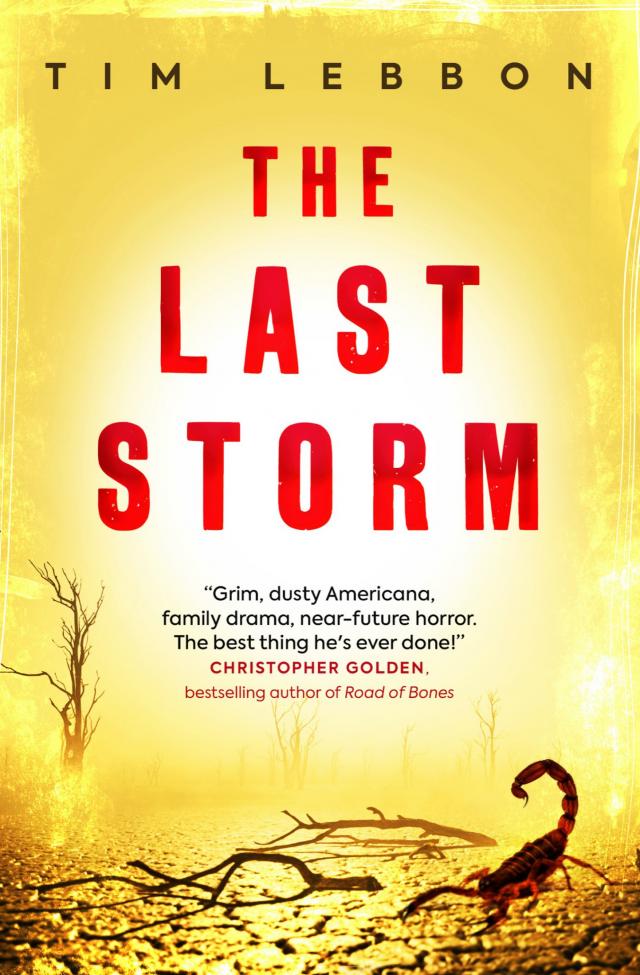
“Grim, dusty Americana, family drama, near-future horror. The best thing he’s ever done!”—Christopher Golden, bestselling author of Road of Bones
“Tim Lebbon is always good, but this time he’s outdone himself. Dry climate and wet hopes collide in a compelling novel of terror and outstanding originality.”—Joe R. Lansdale, author of the Hap and Leonard series
“This dust-choked, sun-baked, adrenaline-fueled quest through a nightmare future will thrill and move you while also sounding the alarm on the dangerous direction we’re spinning as a planet. Tim Lebbon is a prophet of a poet.”—Benjamin Percy, author of The Unfamiliar Garden, The Ninth Metal, and Red Moon
“Expertly crafted horror that resonates with emotion and the messy complications of family.”—Kelley Armstrong, #1 New York Times bestselling author of A Rip Through Time
“Heartfelt, gripping horror from a master of the genre.”—Sarah Pinborough, Sunday Times #1 and New York Times bestselling author of Behind Her Eyes
“Lebbon’s near-future fable has a power and urgency all its own.”—M. R. Carey, bestselling author of The Girl With All the Gifts
“A wildly ambitious look at family ties, survival, and the magic of hope.”—Sarah Langan, author of Good Neighbors
“Tim Lebbon’s The Last Storm is apocalyptic horror at its very best. A scorched-earth nightmare that is all too believable, The Last Storm is Lebbon’s finest creation, and that’s saying something.”—Richard Chizmar, New York Times bestselling author of Chasing The Boogeyman
“Lebbon is a master of the cross-genre thriller, and The Last Storm is one of his absolute best!”—Tim Waggoner, author of We Will Rise
“I’ve loved Tim Lebbon’s writing since The Silence but this is next level stuff. A hyper-surreal look into a post-climate change future with rich characters, heart, action, terror, and a relentless voice that drags you out and won’t let you go. Tremendous.”—Adrian J. Walker, bestselling author of The End of the World Running Club
“Beautifully written, The Last Storm depicts a near future beset with the terrifying consequences of climate change. But out in the desert, one family has a peculiar talent that may begin to quell the fires… or unleash a new Armageddon. Another must-read from Tim Lebbon, this book grabs you by the throat with the first paragraph and doesn’t let up.”—A.J. Elwood, author of The Cottingley Cuckoo
“Lebbon is the undisputed master of the post-apocalyptic thriller.”—Michael Marshall Smith, bestselling author of The Straw Men
“With The Last Storm, Tim Lebbon brings unflinching apocalyptic terrors but infuses the storm with heart and relatable characters. A thinking person’s apocalyptic novel. Bravo!”—Jonathan Maberry, New York Times bestselling author of Kagen the Damned
“Tim Lebbon has long been Britain’s finest horror writer, but he has outdone himself with The Last Storm, a novel that paints its apocalyptic world so clearly you can feel the heat from the page. Like all the best horror fiction, it is the novel’s humanity, not its monstrosity, that will cling to the reader.”—Stuart Neville, author of The House of Ashes
ALSO BY TIM LEBBON AND AVAILABLE FROM TITAN BOOKS
Eden
Coldbrook
The Silence
THE RELICS TRILOGY
Relics
The Folded Land
The Edge
The Cabin in the Woods: The Official Movie Novelization
Alien: Out of the Shadows
THE RAGE WAR
Predator: Incursion
Alien: Invasion
Alien vs. Predator: Armageddon
Kong: Skull Island – The Official Movie Novelization
Firefly: Generations
LEAVE US A REVIEW
We hope you enjoy this book – if you did we would really appreciate it if you can write a short review. Your ratings really make a difference for the authors, helping the books you love reach more people.
You can rate this book, or leave a short review here:
Amazon.com,
Amazon.co.uk,
Barnes & Noble,
Waterstones,
or your preferred retailer.
The Last Storm
Print edition ISBN: 9781803360423
E-book edition ISBN: 9781803360508
Published by Titan Books
A division of Titan Publishing Group Ltd
144 Southwark Street, London SE1 0UP
First edition: July 2022
1 3 5 7 9 10 8 6 4 2
This is a work of fiction. Names, characters, places, and incidents either are the product of the author’s imagination or are used fictitiously, and any resemblance to actual persons, living or dead (except for satirical purposes), is entirely coincidental. The publisher does not have control over and does not assume any responsibility for author or third-party websites or their content.
Tim Lebbon asserts the moral right to be identified as the author of this work.
Copyright © 2022 Tim Lebbon. All rights reserved.
No part of this publication may be reproduced, stored in a retrieval system, or transmitted, in any form or by any means without the prior written permission of the publisher, nor be otherwise circulated in any form of binding or cover other than that in which it is published and without a similar condition being imposed on the subsequent purchaser.
A CIP catalogue record for this title is available from the British Library.
This novel was written during the first Covid lockdown, so it is dedicated with love to my wonderful family, who kept me safe and sane. My wife, Tracey, my daughter Ellie, and my son Dan. The three best people I know.
TWENTY YEARS AGO
THE STORM BEFORE THE CALM
JESSE
The room was full of bad things. Three wooden crates stacked in one corner contained zip-locked bags of drugs. The lid had slipped from the top crate, and no one seemed concerned. There was nothing hidden here. The table pushed against the opposite wall was strewn with empty liquor bottles, overflowing ashtrays, a cracked mirror dusted with what looked like heroin, a fat roll of dollar bills stained with something that wasn’t water, and a handgun. Propped against the table was an AR15 with a bump stock. Jesse wondered if it was there to intimidate him. It was probably just there.
“So you’re sure you can do this?” the man asked. He was one of the bad things in the room. He sat on a plastic chair, right ankle resting on his left knee. He was heavily bearded, hair expensively cut, and a delicate ring glimmered in his left nostril. He’d said his name was Wolf. It was ridiculous, but Jesse didn’t feel like laughing. A man and a woman stood just behind Wolf. Neither of them had spoken, but they both watched Jesse with calm weariness. He did not know their names, and didn’t want to know. He thought of them as Snake—the tall white guy with a bald head and tattoo of a python eating his left ear—and Harley, the short, muscled black woman in a Harley Quinn T-shirt.
“Yes,” Jesse said.
“Only, we’ve let you in now,” Wolf said, glancing around the place as if it was anything other than a wretched fucking pit. But he didn’t mean the room. “Let you see. Let you know. And you can’t unsee and unknow.”
“I don’t see anything,” Jesse said. “And like I told you, it works best outside.”
“I don’t want you doing it outside,” Wolf said. “People might see.”
“Who?” Jesse asked. Perhaps there was too much challenge in his voice. Snake crossed his arms. Harley shifted from her left foot to her right and back again. Stay calm, Jesse thought, even though calm was the last thing he felt.
“People,” Wolf said, drawing the word out. “Eyes in the sky.”
The man’s alleged concern made no sense. It was absurd. The small blockwork building stood within acres of poppy plants, and if anyone saw Jesse out there doing his thing, they’d also see them. Maybe the guy’s own product was making him paranoid.
Jesse felt sweat running down his back. I’m such an idiot. He should have turned the other way when this opportunity arose, but when contact was first made he and Karina were too broke for him to accept what he was getting into—the secrecy, the guns, and the murdering thugs. And when he realised, he was already in too deep. When he tried to go back on his agreement, they threatened his family with violence. In the end, he had no choice.
The only positive was that he was doing this a thousand miles from home. Karina and his sweet little Ash didn’t even know where he was, and until this was over and he returned home with a wad of much-needed cash, that was how it would remain.
“Don’t worry, nobody knows me,” Jesse lied.
Wolf looked him up and down. Jesse let him, glancing instead at Snake and Harley. He wondered how many people they’d killed between them—and how—and cursed his vibrant imagination. They returned his gaze, expressionless.
He had to stay calm, level, unruffled. It wouldn’t work otherwise.
But he looked at the AR15, and the dusting of heroin, and the roll of stained cash that was probably meant for him, and realised again what a total idiot he’d been.
“Outside, then,” Wolf said, standing from his chair. He clapped his hands together and grinned. “But not for long.”
“It’ll be quick,” Jesse said. Another potential lie. He never really knew how long it would take, and that piled on more pressure. Once, in Omaha, he sat on his own in a dry riverbed for almost five hours before the first patter of light rain speckled the dusty ground.
Snake picked up the AR15 and handgun and left the hut. Harley inclined her head at the door to indicate Jesse should go next, and she and Wolf followed him out. Over his shoulder, Jesse carried a small wooden case on a leather strap. The strap was worn and darkened from years of use. The case was inlaid with an intricate design of a large tree, canopy and roots mirroring each other. Different types of wood had been used to create the design, and over the years some of it had shrunk and fallen out, leaving only a shadowy memory. He had no idea who had made the case or where it came from. It had called to him from an old antique store. It had been empty, and he had filled it with his apparatus.
Wolf had not told his minions to search inside the case. He knew what it contained.
Outside, the heat struck Jesse a physical blow. He squinted, dropping the sunglasses from his forehead back down over his eyes. He plucked the cap from his back pocket and pulled it tight onto his head.
Everything was dust. It coated his damp skin, scratched its way into his eyes and ears, his nostrils, and the cracked creases of his lips. He felt it inside his clothing, settling into the contours of his body and chafing when he walked. It was the dust of dead things. Jesse looked down as he walked and kicked up dry, sterile grit, the ground begging for water to bring it back to life. The sun beat at the back of his neck, seeking to dry him out, leach from him the waters of life. Everything he did was to prevent that from happening, and to stop it from happening to others. He told himself that, time and again. He told Karina and thought she believed him, hoped she did. He needed her to believe. Jesse needed the firm understanding that everything he did was from a position of control. That was the only way it would work. Confusion, stress, tension, fear: all were the enemy of his gift.
Stretching in every direction were row upon row of sickening poppy plants. Suspended above them on a grid of bamboo struts and wires, just above head height, were other creeping plants. He didn’t know their species, only that they too were almost dead. There were irrigation channels and a network of flexible hoses trailing beneath the loose planting structures, but many of the hoses were old and desiccated in the intense, unrelenting sunlight. Wolf had told him that for many years they’d been tapping into the nearby river: then, when that dried up, the reservoir six miles away in the hills. Last year, that had also gone dry. The shrubs used to camouflage the crop had dried and died first, leaving the poppy fields exposed to aerial surveillance. It was only a matter of time before they were found out.
That was why Jesse was here, with his apparatus in the wooden case slung over his shoulder. He had come to make rain to save the crop and fill their water storage facilities. For that, Wolf had promised him sixty thousand dollars.
The art of his gift was what drove him, but there was also the money. And there was also his unspoken certainty that, whether his attempt worked or not, this crop was doomed. If he could not bring rain, the plants would not last another month. If he could usher in a downpour, it would not only be a mere shower. That was not how it worked. His level of control was not quite as refined as he had claimed to Wolf. If and when his rains fell, they would do so in a storm that might wash away the loose, dried soil, flood the fields, strip away and drown many of these illicit crops.
Jesse knew he was an idiot. He only hoped he could take the money and run before the full deluge arrived and Wolf realised what he had done.
“Where?” Wolf asked.
“Here is fine,” Jesse said.
“You’re sure?” The drug farmer was eager and excited to see what Jesse could do. It was a normal reaction, but Jesse didn’t regard Wolf as a normal man.
Snake and Harley moved away, giving him distance and space as he stood looking around. The suspended camouflage crop was mostly pale, a sandy colour with occasional wan green patches where some plants clung to life. It was a familiar scene. The drought was deep and long; the world continued to change and, however much Jesse tried to help, he was little more than a speck of sand on a vast beach.
“So, what happens now?” Wolf asked.
“I set up,” Jesse said. He paused, looking directly at Wolf. “I need peace. And quiet. And solitude.”
Wolf gazed at the wooden box hanging from Jesse’s shoulder.
“Is it true you have to stick needles in your arms?” Wolf asked.
“It’s nothing like that,” Jesse said, trying to keep the disgust from his voice. But as Wolf shrugged, turned, and walked away, he had to wonder whether it was more similar than he’d care to admit.
Jesse breathed deeply a few times and turned his face to the sky. It was clear and pale blue, scorched almost cloudless by the unrelenting sun. He remembered his mother doing the same, and he had a rich, living memory of the first time he’d asked what she was doing. He’d been maybe five years old then, and she had been five years away from the flames that would consume her.
I’m wishing upon a cloud, she’d said, laughing as Jesse assumed the same position. See that one, son? It looks like an elephant.
He saw no elephants now. There were a few scattered cirrus clouds so high up that they were barely smudges against deep blue infinity. Other than that, the sky offered no signs of rain.
Jesse shrugged the box from his shoulder and opened the metal fastenings. Placing it carefully on the dusty ground, he knelt before it and opened the lid. The lid’s underside was still vibrant with the inlaid tree design, as if only the outside had been weathered and worn away by time. He sometimes wondered whether he was also like that. He was approaching forty, but sometimes it felt as though he’d already lived two lifetimes.
Continuing his deep breathing, he took out the apparatus. It was light and small, the length of his forearm, comprised of a series of tubes and bulbs, electrical components and brass casings, and other pieces gathered and gleaned from many sources. He’d built it as a teenager, hearing his mother’s whispered encouragement in his mind with each element he added, the turn of every screw. At one end was the focus, and he turned the dial that extruded the small, pointed horn that would aim at the sky.
Closing the lid of the box, he placed the locator pins in their corresponding holes, and then he was almost ready.
Almost.
He took two long wires and unspooled them, ensuring that both ends were connected correctly to the apparatus. Then he extracted two sterile needles from their lined container on one edge of the device and fitted them to the ends of the wires.
He glanced up to see Wolf watching from twenty metres away.